
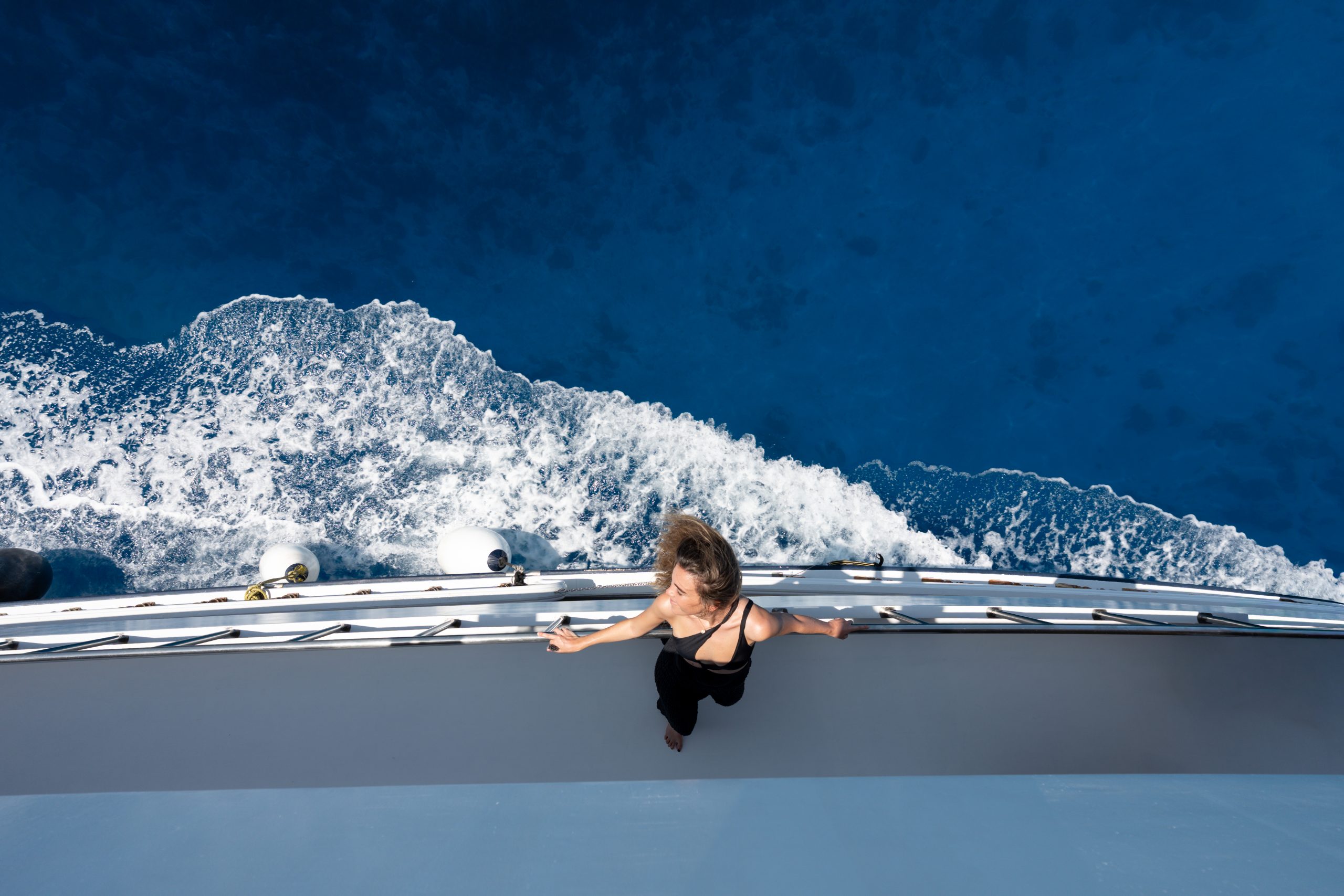
We spent a week aboard the Conte Max along the southern route of the Maldives and came back with one certainty: experiencing diving from a liveaboard completely changes the trip.
In this guide we tell you what the experience is really like day by day: which animals you see on the southern route, what the dives are like, life on board and whether it’s truly worth it.
We also share the practical details and tips we wish we’d known beforehand: for example that the water was so warm we skipped the wetsuit some days, that the Conte Max is so good it’s worth booking well ahead and, if you’re nitrox certified, we highly recommend it.
A week of diving, snorkelling and sunsets that’s hard to forget.
Map of the Maldives liveaboard south route (7 days)
This map shows the 7-day Maldives liveaboard south route aboard the Conte Max, atoll by atoll: Laamu, Thaa, Meemu, Vaavu and Kaafu, with the best channels and dive sites (mantas, sharks and the Alimatha night dive). Use it to place each dive and picture the cruise route before you board.
South Route Liveaboard, Maldives
Conte Max Boutique Liveaboard
Get ready to discover what a week on the Conte Max is really like: how life aboard actually works, what it feels like to live on a Maldives liveaboard, what marine life you can spot on the south route — and, most importantly, whether it’s worth it. Because what you imagine and what you actually live through are two completely different things
The Essence of the Boat
The Conte Max is a 33-metre boutique liveaboard. We absolutely loved it.
Spending a week sailing is a genuine dream. Conte Max is designed especially for:
Snorkellers and divers alike — you can do both.
Couples, because the Maldives combined with the slow pace and the ocean all around makes this one of the most special things you can do together.
Also perfect for groups of friends who want to properly switch off for a week in the middle of the ocean, sharing dives, meals and sunsets from the deck.
When to Visit the Maldives
The best time for a Maldives liveaboard is November to April, during the dry season. Pack light summer clothes — temperatures hover between 27°C and 30°C, the sea is generally calmer and underwater visibility is excellent.
We travelled in April and had great conditions throughout the entire week.
The truth is that the Maldives is a dive destination that works all year round. Even in the wet season, a great dive is almost guaranteed.
Getting to the Maldives and Boarding the Conte Max
The main entry point is Velana International Airport (MLE), in the capital, Malé.
We’d recommend arriving with a comfortable buffer to avoid any issues with delays or missed connections.
Depending on where the route starts, you can board in Malé or take a short domestic flight that the Conte Max team organises for you.
They also handle airport pickup and transfer to the boat, so the whole process is pretty seamless.
The Soul of the Conte Max
Conte Max was born from a European dream with a Maldivian soul. Both cultures come together through a remarkable team.
From the very first email with Valentina to plan the trip, the warmth was immediately there. We later got to meet Dodi, the general manager, and quickly understood why they’ve been a reference among Maldives liveaboards for over 20 years.
On board, Diego — the boat director — and the entire crew made the experience even more special. They genuinely know these waters and every spot inside out.
Well done, Conte Max.
What's diving like on the South Maldives route?
If you’re considering a Maldives liveaboard and want to know what the diving is actually like, here’s how we experienced it.
Visibility. Incredible. Between 20 and 30 metres on almost every dive — some of the best we’ve had anywhere. Not a single day of bad visibility.
Water temperature. Warm. So warm that on some days we didn’t bother with a wetsuit. The boat provides 2mm wetsuits which are more than enough.
Currents. They exist, but they’re well managed. The Maldives has a reputation for strong currents and it’s deserved, but the boat handles them really well — timing the entry point precisely so you’re working with the current, not fighting it. If in doubt, you can hire a reef hook on board.
Type of diving. Mostly drift dives through channels, with vertical walls on one side and pelagic life drifting past. Also calmer coral gardens and specific spots like manta cleaning stations.
Average depth. Between 18 and 30 metres. If you have a nitrox certification, we’d strongly recommend it. On the Conte Max it’s free with the qualification, and it lets you safely extend your bottom time.
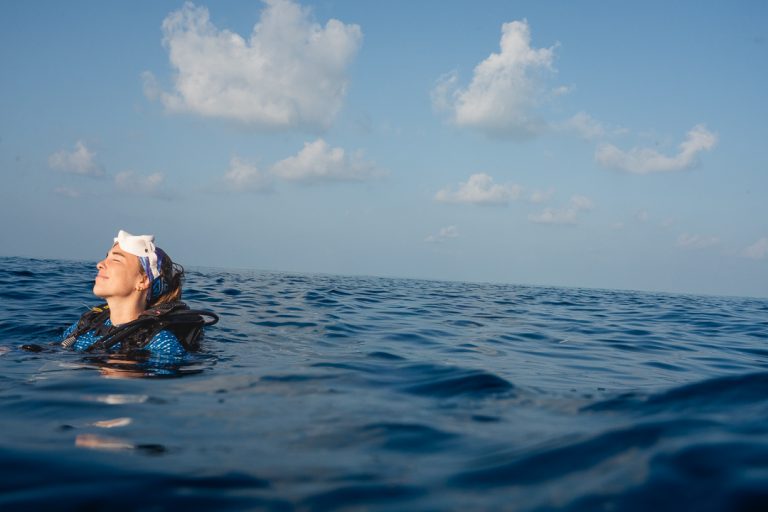


We’re in the middle of the Indian Ocean, in a chain of 26 atolls that create channels, vertical walls, coral gardens and cleaning stations. That geographical variety explains why a single dive can throw everything at you: turtles, mantas, mobulas, several species of sharks, huge schools of tropical fish, barracuda, eagle rays — and if you’re lucky, even a whale shark.
On this trip we saw things we hadn’t expected to see. A hairy mantis shrimp — the rare variety — which we’d genuinely never spotted before and dolphins joining us mid-dive. But not only that we saw many Grey reef sharks swimming in formation directly overhead. Mantas at a cleaning station. And two or three turtles per dive. For us, the Maldives is one of the most complete diving destinations in the world. We’ve dived all over the archipelago: from an island with its own dive centre, like diving at Kuramathi, to a more budget-friendly local island, like diving in Maafushi.
The Maldives is one of those destinations where diving never disappoints. Rain or shine, current or not, you almost always come up from a dive full of marine life. And the South route is just amazing. If you’re planning your trip and would rather explore the country on land, island by island, instead of aboard, we cover it all in our Maldives itinerary.
Areas of the Conte Max
The first thought when we stepped aboard the Conte Max was: “there’s room for everyone.” That matters to us — we’ve been on boats where you’re constantly bumping into someone — and the Conte Max is the opposite. It has a real sense of space and calm.
The boat is certified for 22 guests but typically sails with 17 or 18. That difference means you always find your spot on the sun deck at any time of day, there’s no queue at the dive station and meals don’t feel like a school canteen.
We genuinely spent a week feeling comfortable and at ease. A spacious boat with a pace that matched it.
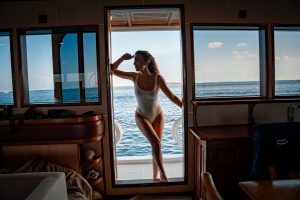
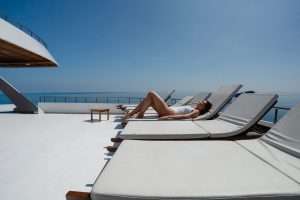
The Conte Max has three decks, and depending on the time of day you naturally gravitate towards different ones. The lower deck is the social hub: the main lounge, the stern dining area and the shaded bow deck for surface intervals. The second deck is the sun terrace: hammock zone at the stern where we spent hours reading and letting wetsuits dry in the breeze. And up top, the sun deck — where we flew the drone, had drinks at sunset and lay watching the stars at night (in the Maldives with zero light pollution, the sky is genuinely stacked).
Three things surprised us most about the boat: the Starlink wifi that genuinely works in the middle of the Indian Ocean, the paddleboard and two kayaks available at sandbank stops, and the bar that opened every evening after the last dive. But honestly, above all else, what surprised us most was the crew. Eight people on board looking after every detail, every one of them genuinely warm.
9 cabins, 3 types
The Conte Max has 9 cabins across two decks, in three different layouts depending on what you need. All cabins have a private bathroom and air conditioning.
Double cabins with extra single
Twin cabins (two singles)
Main deck cabin
Cabins 1, 2, 7 and 8 are in the lower deck and are the most comfortable for couples: a queen double bed plus an extra single that works well as auxiliary storage. They sleep up to three.
Cabins 3 and 6, also in the lower deck, are twin cabins with two single beds. Ideal if you’re travelling solo or with a friend who prefers their own bed.
Cabin 9 is the only one on the main deck. Also twin, but with the advantage of being just a step away from the main lounge — no stairs in between.
Our cabin
After seven nights living in it, we can say it was one of the pleasant surprises of the trip.
The bed. Very comfortable queen double, which we used as the main sleeping spot. The extra single ended up as our storage zone — bags, clothes, cameras and chargers all week. That extra space is something you genuinely appreciate when you’re living in a cabin for seven days.
The bathroom. Spacious, with good water pressure and enough room to move around without contortions. Honestly almost as big as the one at home. Sink, mirror, proper shower area and enough space to hang towels and keep toiletries organised.
The air conditioning. Maldives nights are hot, and after three dives all you want is to walk into your cabin and feel cool. It ran quietly, no strange noises, and we kept it on all night.
One note. Being in the lower deck, you do feel the engine when the boat sails at night. Nothing unbearable. After this many liveaboards we always travel with earplugs — they’re almost always needed.
Life aboard
The daily rhythm
A lot of people think liveaboards are exhausting. Three dives a day, briefings, gear, transfers. We’ll be honest: the Conte Max schedule is demanding, but it’s so well organised it ends up feeling relaxing.
We woke at six for the first dive of the day, came back to the boat hungry and fell straight into breakfast. Then a proper rest. Around eleven, another dive. Lunch. A real break this time — optional nap or hammock with a book. In the afternoon, the third dive, which some days was swapped for a trip to a local island or a sandbank.
One afternoon they took us to a sandbank where we spent a couple of hours paddleboarding and snorkelling in impossible shades of blue while dolphins passed in the distance with the evening light behind them. Another night the crew set up a full dinner on a deserted island — candles, fairy lights and a barbecue they built right on the beach. It turned into a small impromptu party in the middle of nowhere.
One of the Conte Max’s standout features is its partnership with Manta Trust. Fiona, the marine biologist thst travelled with our expedition, comes from this NGO dedicated to manta research and conservation worldwide. Through this partnership she gave optional talks in the late afternoons as the sun went down — covering everything we’d seen that day in a level of detail that genuinely changes how you look at the ocean. Learning while you dive is one of those things you only understand once you’ve lived it.
Congrats to Conte Max and Manta Trust for this partnership — and for looking after the planet. We’re fans.
Food and atmosphere on board
On a liveaboard, meals set the rhythm of the day just as much as the dives. And on the Conte Max, we found ourselves genuinely looking forward to each one. There are two types of liveaboards when it comes to food: those with a buffet and those where you’re served at the table. The Conte Max serves you at the table, and for us that makes all the difference.
Breakfast. You could order the eggs the way you felt like (we loved this!), and you will be offered freshly made pancakes, crispy bacon, incredibly fresh tropical fruit, yoghurts, toast, jams, fresh juices… Some days a full international breakfast, others something lighter and more continental. Something different every day.
Lunch and dinner. Local Maldivian food with a Western touch that worked for every palate. Mild fish curries, aromatic coconut rice with spices, grilled fresh fish, prawn skewers, tropical fruit salads, local soups. Alongside that, more familiar options: pasta, chicken, potatoes, Mediterranean salads, freshly baked bread. Everything gently dialled back on the spice.
Desserts were homemade and surprised us every day. Tropical cakes, panna cottas with fruit, sponge cakes, coconut and mango desserts.
The bar opened after the last dive of the day. Beer, wine, tropical cocktails. Heading up to the sun deck with a cold drink just as the sun went down was our small evening ritual. The sunsets were incredible!


A route almost nobody does
Laamu Atoll
· DAY 1 ·
Most Maldives liveaboards stick to the central route — departing from Malé and returning to Malé after a week. Our route was different: the Conte Max spends part of the year in the south and works its way north towards Malé. We caught exactly that south-to-centre transition, which let us dive five atolls (Laamu, Thaa, Meemu, Vaavu and Kaafu) and experience what each one offers.
Spots: Fushi Kandu · Kadhdhoo Giri
Dives: 2
Highlights: turtles, eagle rays, grey reef sharks, octopus, barracuda, mantis shrimp, dolphins (during navigation).
Day one. We flew into the Conte Max after a short domestic flight with Air Maldives from Malé. The boat was already waiting for us in Laamu Atoll, in the south of the country. As soon as we boarded they showed us the cabins, handed out wetsuits, ran the first briefing and, before we’d barely said “Maldives”, we were already heading towards the first spot.
We started at Fushi Kandu, a channel with moderate current and jaw-dropping visibility. The first dive was supposed to be a gear check — calm. Spoiler: it didn’t stay calm for long. We hadn’t even settled when several turtles appeared, eagle rays glided past and a couple of grey reef sharks crossed the outer wall. What a way to start.
The afternoon took us to Kadhdhoo Giri, a coral formation in the same atoll. More relaxed, less current, and the coral in incredible shape. Octopus camouflaging at a masterful level, eagle rays crossing in pairs, barracuda forming a spinning column, parrotfish chomping on coral and, best of all, a mantis shrimp showing off those impossible colours. Every time we spot one, we spend the rest of the day grinning.
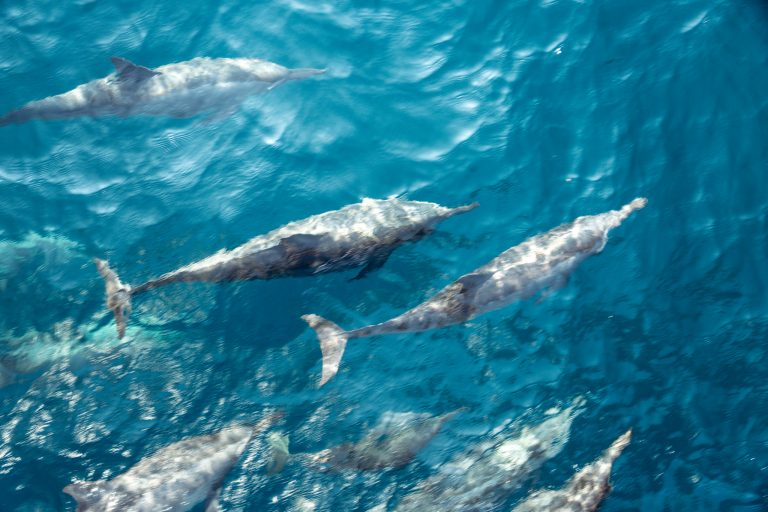
The bonus came during the sail back. Out of nowhere, about twenty dolphins appeared jumping alongside the bow. We ran up to the sun deck with the drone and spent a good while filming. Day one and the trip already looked like something else.


Thaa Atoll
· DAY 2 ·
Spots: Maabaidhoo Beyru · Maabaidhoo Kandu · Fahala Giri
Dives: 3
Highlights: grey reef sharks, turtles, Napoleon wrasse, barracuda schools, eagle rays.
Day two and the boat had sailed overnight towards Thaa Atoll, a zone far less visited than the central route. Liveaboards rarely come here, which translates into near-pristine reefs.
We started at Maabaidhoo Beyru, the outer reef face looking over open ocean. Drift dive with moderate current, a dramatic vertical drop-off and deep blue water. Grey reef sharks patrolling, eagle rays, barracuda forming a column and a massive Napoleon wrasse that just hovered there watching us. When we surfaced, the dive masters said “elsewhere that would be the dive of the year — here it’s just the warm-up.”
Mid-morning we moved to Maabaidhoo Kandu, the channel connecting the atoll to the ocean. Stronger current, proper drift dive conditions, huge fusilier schools, trevally hunting in formation and more reef sharks.
In the afternoon, Fahala Giri, a spectacular coral formation rising from the blue. A calmer dive, perfect for ending the day. Octopus again, big parrotfish, several morays, fusilier schools and a large group of jacks hunting sardines in full action.


That same night, the crew switched on the boat’s powerful floodlights pointing down into the water. And we were lucky enough to have a whale shark come right up — it spent about three hours swimming around the boat.
We put on masks and fins and jumped in. Just us and a whale shark, no other boats around, no crowds.
What a thing to witness!
Meemu Atoll
· DAY 3 ·
Spots: Dhiffushi Kandu · Kureli Manta Point · Raabandhu Hura Beyru
Dives: 3 + desert island barbecue
Highlights: mantas at cleaning station, grey reef sharks, eagle rays, turtles, fusilier and barracuda schools.
Day three and we’d been told: Kureli Manta Point was up, one of the most famous manta spots in the Maldives. We came with high expectations — and they were met, no question.
The morning dive was at Dhiffushi Kandu, a channel with moderate current and spectacular visibility. Classic drift dive, vertical walls, grey reef sharks, eagle rays crossing in groups, turtles and fusilier schools.
Kureli Manta Point. is a manta cleaning station — a specific spot on the reef where small fish remove parasites from the mantas. The mantas come in and stay almost motionless for minutes. You lie flat on the bottom, completely still, and they’re just metres away. We saw several mantas during the dive; one came so close we could see her gill plates in detail.
In the afternoon, Raabandhu Hura Beyru — a dive on the outer wall. Stronger current, deep blue, grey sharks passing below, tuna hunting and healthy coral throughout.
Then came the surprise. The crew took us to a deserted island and set up a full barbecue right on the beach: torches, fairy lights, tables, chairs and dinner. We ended up eating with our feet in the sand, the sound of the ocean all around. After a few beers it turned into a small impromptu party, dancing included.
Vaavu Atoll
· DAY 4 ·
Spots: Gaahura Kandu · Rakeedhoo Kandu · Fotteyo Kandu
Dives: 3 + sandbank afternoon (Fotteyo Finolhu)
Highlights: grey reef sharks, mantas, eagle rays, Napoleon wrasse, huge trevally school, yellow soft corals, giant hermit crabs, dolphins (sunset).
Day 4 and we entered Vaavu Atoll, one of the most celebrated dive atolls in the whole Maldives. At breakfast, the dive masters came over and said “today’s going to be a good one at Fotteyo.” Everyone finished eating at double speed.
First dive at Gaahura Kandu, a channel with good current, vertical walls and plenty of pelagic life. Second at Rakeedhoo Kandu, another beautiful channel with perfect coral, a huge Napoleon, hunting tuna and a barracuda column in the blue. And then came Fotteyo Kandu, one of the best dive sites on the planet. Walls covered in yellow soft coral, overhangs, caves, underwater passages. Drift dive with sharks of every kind (grey reef, blacktip, whitetip) and a massive school of trevally passing directly overhead like a silver cloud.
In the afternoon, the boat anchored near Fotteyo Finolhu, a sandbank in turquoise waters. They deployed the paddleboards and kayaks and we spent a couple of hours paddling and swimming through impossible shades of blue. On the small exposed section we found giant hermit crabs, some the size of our fist. We’d never seen ones that large. And as the sun dropped, several dolphins appeared in the distance jumping between the waves in that golden evening light.
Vaavu Atoll (Alimatha)
· DAY 5 ·
Spots: Fotteyo Kandu · Devana Kandu · Miyaru Kandu
Night anchorage: Alimatha
Dives: 3 + night experience with nurse sharks
Highlights: grey reef sharks, whitetip and blacktip reef sharks, nurse sharks (40+), eagle rays, mantas, pelagics.
Day 5 and we were heading into what many consider the most legendary day in Vaavu. Three channels and, as the cherry on top, a night that’s hard to put into words.
First dive at Fotteyo Kandu, second visit. And no, it’s not repeating yourself — every dive here is different. This time we hit stronger current, grey sharks very close and the yellow soft coral at its absolute best. Second at Devana Kandu, with several whitetip reef sharks resting on the bottom, eagle rays and fusilier schools. Third at Miyaru Kandu, which literally means “Shark Channel” in Dhivehi. Drift dive in incoming current, vertical walls and a group of three large grey reef sharks patrolling in formation along the outer face. The best part, at the end of the dive a school of dolphins came to say hi, and we waved back :).
While sailing someone shouted “Killer whales!” and we ran to see them, they were not Orcas but Pilot Whales, for us even better as we saw them jumping continuously, such a rare sight!
At night, the boat anchored at Alimatha, one of the most famous nurse shark spots in the Maldives. The crew switched on powerful floodlights pointing straight down into the water. Those lights draw nurse sharks in directly. One, two, five, ten. Before we knew it there were over 40 nurse sharks circling just below the surface. You put on your mask and fins and drop in. Being surrounded by 40 nurse sharks moving silently under the boat’s floodlights is one of those experiences that’s unlike anything else.
Kaafu Atoll
· DAY 6 ·
Spots: Dhiggiri Shark Point · Kandooma Thila · Villivaru Giri (night dive)
Afternoon: Guraidhoo Local Island
Dives: 2 day dives + 1 night dive
Highlights: nurse sharks, grey reef sharks, Napoleon wrasse, eagle rays, octopus, morays, night reef life.
Day 6 and we moved into Kaafu Atoll, the last atoll before Malé. We started with Dhiggiri Shark Point, famous for its nurse shark concentrations. Not a drift down a vertical wall — a sandy bottom area where sharks cruise past continuously. You lie flat, stay still, and watch them file past at arm’s length. One of the closest encounters we’ve had with the species.
Second dive at Kandooma Thila, an iconic pinnacle in Kaafu. The thila rises out of nowhere in the blue. Grey reef sharks circling the pinnacle, a very large Napoleon hugging the wall, eagle rays crossing the shallower zone and massive fusilier schools.
In the afternoon the boat stopped at Guraidhoo Local Island. We decided to stay on board — we’ve visited several local islands on previous trips and they’re fairly similar — so we used the time to rest and take sunset photos from the sun deck.
To close the day, a night dive at Villivaru Giri. The reef transforms: daytime hunters go to sleep and the nocturnal ones emerge. Torch in hand: octopus out hunting, morays snaking through crevices, shrimps glowing with fluorescent colours, fish sleeping tucked into coral pockets and endless macro life impossible to spot by day.
Kaafu Atoll → Malé
DAY 7 · Back to Malé
Spots: Kandooma Thila (return visit)
Afternoon: Emboodhoo Sand Bank → arrival in Malé
Dives: 1
Highlights: resident green turtles, hairy mantis shrimp, grey reef sharks, eagle rays, Napoleon wrasse, massive fish schools.
Last day, last dive. We woke up before the alarm even went off. Quick coffee, briefing and into the water one final time.
We ended at Kandooma Thila again. And two things happened that we hadn’t expected.
The first: the resident green turtles. Kandooma Thila has a small community of green turtles that live there almost year-round. We spotted three different ones — two large adults and a smaller one. One of them hung around next to us longer than any tourist deserves.
The second: a hairy mantis shrimp. The mantis shrimp is already our favourite animal in the sea. The hairy variety is the rare one among the rare — covered in tiny bristles, with extraordinary camouflage. The encounter was brief; it shot back into its burrow almost immediately, but we had a few seconds with it.
And in between, the usual Kandooma cast: grey reef sharks circling the pinnacle, eagle rays gliding past, a massive Napoleon and a silver curtain of fusiliers all around us.
Important: safety and confidence in the water
One of the things we value most in a liveaboard is the feeling of being safe. In the water, everything’s fine until it isn’t — and that’s where having a professional team behind you makes all the difference. On the Conte Max, this part is thoroughly covered.
Dive Masters — attentive and always in control
Diego, the boat director, has been diving these waters for over 20 years and knows every spot like the back of his hand. The dive team is mix local, highly experienced. Groups are a maximum of four divers per dive master, which means you’re always covered. If you struggle to equalise, they wait. If you’re running low on air, they’ll tell you and surface with you. One of us has always had a slightly harder time descending at the start, and without exception, every single time, the dive master was right there waiting for as long as needed.
Are there currents in the Maldives?
Yes, there are, and it’s worth knowing. The Maldives has a reputation for strong currents in certain channels, particularly the famous kandus. On our trip they were mostly moderate — what you’d call low-to-medium — and we never once felt out of our depth. The key is that the boat manages them really well, timing the entry point precisely so you’re riding the current rather than fighting it. If you’re unsure, you can hire a reef hook on board and anchor yourself to the reef.
Before getting in the water
Every pre-dive briefing is thorough and clear. They cover the site topography, dive plan, maximum depth, expected currents, what marine life to look for and emergency signals. If you’re a newer diver, they take more time with you. If you’ve got a lot of dives under your belt, they skip the basics. They were always helpful and make you feel secure.
Our experience on the Conte Max
Why we keep coming back to the Maldives
An incredible liveaboard
This was our fifth time in the Maldives. Five. And it still surprises us every visit.
Above the surface it’s breathtaking, and below, the marine ecosystem is one of the richest on the planet. The volume of large marine life, the reef health, the visibility and the sheer variety of diving is something that’s hard to match. And after five trips, we still see new things — this time dolphins joining us mid-dive and a hairy mantis shrimp.
After seven days living aboard, we can say without hesitation that the Conte Max is one of the best liveaboards we’ve been on. That means a lot — we’ve done quite a few liveaboards in different parts of the world.
What we loved most is the combination of a premium boat with a boutique atmosphere: limited capacity, generous spaces, attentive crew and a level of service that shows from the first breakfast to the last beer on the sun deck.
On the Conte Max you won’t feel like a tourist or a client. The crew is genuinely warm — not commercially warm, actually warm. They’ll do everything to make you feel at home, they’ll learn your name, share their own stories honestly and listen to yours with real interest.
Special mention to the whole crew: Diego, Ipe, Chamika, Rasheed… And Dodi and Valentina who helped us plan the trip. They made the difference and elevated the whole experience to another level.
It’s not a cheap trip (around €1,500 per person per week, plus flights and extras), but it earns every euro. Not many places have everything: beauty, intimacy, great food and real soul.
Conte Max was for us a place of genuine peace where we actually switched off, while at the same time living some of the best adventures of our lives.
Our recommendation: if you love diving and you’ve been on the fence about investing in a Maldives liveaboard, stop sitting on it. The Conte Max is one of the best boats we’ve tried anywhere (we recommend it with our eyes closed), and the south route is a genuinely incredible option for avoiding the crowds and diving spots like Fotteyo Kandu or Miyaru Kandu in near-exclusive conditions.
We still have the deep south left to discover — that part of the archipelago that keeps its best secrets for those who earn them. We hope to go back one day to finish what was left. And maybe, if we’re lucky, to step foot on this boat again. Perhaps that’s why the last day felt different. Not sad, but with that strange feeling of leaving something unfinished. Because some boats take you from one place to another, and then there’s the Conte Max — the one that leaves you not wanting to reach any port at all.
Because a week aboard the Conte Max doesn’t satisfy you. It opens your appetite.
We leave the contact details below:

- Web: https://www.luxuryyachtmaldives.com/
- Email: booking@luxuryyachtmaldives.com
Frequently asked questions about the Conte Max and Maldives liveaboards
We answer the most common questions about the Conte Max and Maldives liveaboards, based on our own experience.
How much does a Maldives diving liveaboard cost?
A Maldives diving liveaboard costs between €1,500 and €4,000 per person per week, depending on the boat and level of service. The Conte Max sits around €1,500 for the week and includes cabin accommodation, all meals, up to three dives per day and most extras. On top of that you’ll need to budget for international flights (roughly €800–1,200 from Western Europe) and optional costs like tips or equipment rental.
What's the best time to dive in the Maldives?
The best time to dive in the Maldives is December to April, when there’s less rainfall, better visibility (20–30 metres), calmer seas and higher chances of spotting large marine life. The Conte Max south route works especially well in March and April, during the transition from the southern to the central Maldives.
How do you get to the Conte Max in the Maldives?
Getting to the Conte Max requires two or three flights. An international flight to Malé (via Istanbul, Dubai or Doha from most European hubs) and then a short domestic flight with Air Maldives — under an hour — to the atoll where the boat is. Albatros Top Boat handled the domestic flight arrangements for us.
Do you need a visa to visit the Maldives?
No visa is required to visit the Maldives for most nationalities. A free 30-day tourist visa is issued on arrival. You do need to fill in the Imuga online arrival form before boarding your flight. Imuga is free on the official site (imuga.immigration.gov.mv) — be careful of third-party websites that charge for something that’s completely free.
Is dive insurance required for the Maldives?
Yes, dive insurance is required in the Maldives. Without a specialist policy covering hyperbaric chambers and maritime rescue you won’t be able to board a liveaboard or book dives. Providers like DAN, PADI Insurance and similar companies offer policies from around €30–50 per week.
What diving certification do I need for a Maldives liveaboard?
Open Water Diver is the minimum, but Advanced Open Water is strongly recommended to make the most of the deeper dives and drift dives through channels. Some boats like the Conte Max can certify you on board, but you’ll lose several dives in the process. Ideally, arrive already certified.
Are there strong currents when diving in the Maldives?
Yes, there are currents — especially in the channels (kandus). They range from moderate to strong depending on the tide, but they’re well managed on liveaboards like the Conte Max. The dive masters pick the exact timing and entry point to work with the current. You can always rent a reef hook on board.
What food do they serve on the Conte Max?
The Conte Max serves local Maldivian cuisine alongside Western options, gently spiced to suit any palate. Food is served at the table, not buffet-style. Customisable breakfasts, lunches and dinners featuring fresh fish, mild curries, pasta, salads and homemade desserts. Bar serving beer, wine and cocktails after the last dive.
Is there wifi on the Conte Max?
Yes, the Conte Max has Starlink wifi that works reliably even in the middle of the Indian Ocean. It’s one of the few Maldives liveaboards with a stable connection throughout the entire trip, letting you work briefly or upload photos without any trouble.
How much cash should I bring for a Maldives liveaboard?
You don’t need much cash on a liveaboard since almost everything is included. Budget mainly for tips, any optional excursions and occasional purchases. The local currency is the Maldivian rufiyaa, but euros and US dollars are accepted in most places.
Is tipping expected on a Maldives liveaboard?
Yes, tipping is customary and very much appreciated. On a liveaboard, the standard tip is 10% to 15% of the total trip cost per guest. Take into consideration that the tip is to be shared among the full team (dive masters, cook, cabin crew, deck team.). With us they were amazing and elevated the experience to another level.
What to pack for a Maldives liveaboard?
Pack: waterproof sunscreen, motion sickness tablets (Dramamine or Stugeron), earplugs, light summer clothes, flip-flops, swimwear, an underwater camera or GoPro, a personal torch and a book. Long hair? Bring a detangling spray. You do NOT need towels (the boat provides them), closed shoes or a mosquito net.
What's included in the Conte Max liveaboard price?
Included: cabin accommodation with private bathroom and air conditioning, all three meals daily, up to three dives per day with a dive master, free nitrox with certification, towels, water, tea and coffee. Not included: flights, dive insurance, equipment rental, alcoholic drinks or tips.
What does a typical day on a Maldives liveaboard look like?
It starts at 6:00am with the first dive. Breakfast at 8:00am, second dive around 11:00am followed by lunch and a proper rest. The third dive is around 3:30pm, then dinner at 8:00pm. On the Conte Max there are also optional marine biology talks in the evenings and occasional night dives.
OTHER MALDIVES eXPEDITIONS
THE EXPLORE TV RECOMMENDATION
Kuramathi: 3 Days of Relaxation in Maldives' Turquoise Paradise
#HOTEL EXPLORE
Want to know how our three dream days in this turquoise paradise went?
We’ve put together a detailed experience with recommendations, stunning photos and practical tips to help you plan your trip. If you’re thinking of visiting Kuramathi or simply need inspiration for your next big escape, this is your article.
#HOTEL EXPLORE
Want to know how our three dream days on this tiny island went?
We’ve put together a detailed experience with recommendations, stunning photos and practical tips to help you plan your trip. If you’re thinking of visiting Kandolhu or simply need inspiration for your next big escape, this is your article.


